
Carbon fiber and glass fiber filaments can produce incredibly stiff, lightweight, and dimensionally stable parts.
But they come with a challenge many users don’t expect:
They can be surprisingly brittle on the spool.
If you’ve ever had carbon fiber filament snap during feeding, break inside a PTFE tube, or fail inside an AMS system, you’re not alone.
Fiber-reinforced filaments often require different handling than standard materials.
In this guide, we’ll cover why brittle filaments break, how to prevent feeding problems, and how to print reinforced materials successfully.
Why Are Some Filaments Brittle?
Not all filaments behave the same.
Fiber-reinforced materials often contain chopped additives such as:
- Carbon fiber (CF)
- Glass fiber (GF)
- Mineral reinforcements
- Specialty engineering fillers
These additives increase:
- Rigidity
- Strength
- Dimensional stability
But they can also reduce spool flexibility.
That’s why some filaments may feel stiff or even snap when bent.

What Causes Brittle Filament to Break?
Several things can make brittle filament worse.
Moisture Exposure
Even reinforced materials can absorb moisture.
Wet filament may become harder to print and sometimes more prone to feeding issues.
Drying often helps restore performance.
Long-Term Storage or Vacuum Packaging
Some materials can become overly dry or stressed after long storage.
Outer wraps may be more fragile from prolonged tension.
Some users remove the first portion of filament before printing for this reason.
Fiber Content and Formulation
Some composites are naturally more brittle than others.
Not all carbon fiber filaments behave the same.
Formulation matters.
Some feed easily.
Others need special care.
Dry Brittle Filament Before Printing
This is often the first fix.
Drying can help:
- Improve layer adhesion
- Reduce breakage risk
- Improve extrusion consistency
Use:
- Filament dryer
- Dry box
- Oven (following manufacturer guidance)
For engineering materials, drying is often essential.
Not optional.
Remove the First Portion of Old Filament
If a spool has been stored for a long time, the outer wraps may be the most stressed.
Some users remove the first 50 grams or so before printing.
That can reduce unexpected snapping from brittle outer layers.
Simple but surprisingly effective.

Keep the Filament Path Straight and Gentle
This is huge.
Brittle filament hates sharp bends.
Every tight curve adds stress.
Try to create the straightest, smoothest path possible.
Avoid:
- Sharp PTFE bends
- Tight routing
- Excessive drag
- Complex filament paths
A direct path is often much more reliable.
Multi-Material Feed Systems Can Be Problematic
Systems with long or complex feed paths may be harder on brittle materials.
Fiber-filled filaments often perform better with:
- Direct spool feeding
- Shorter paths
- Minimal routing friction
The less twisting and bending, the better.
Direct Drive Often Helps
Direct drive extruders are often preferred for brittle materials.
Why?
They generally provide:
- Better filament control
- Less path resistance
- Less stress on rigid filaments
For many fiber composites, direct drive improves feeding consistency.

Use the Right Nozzle
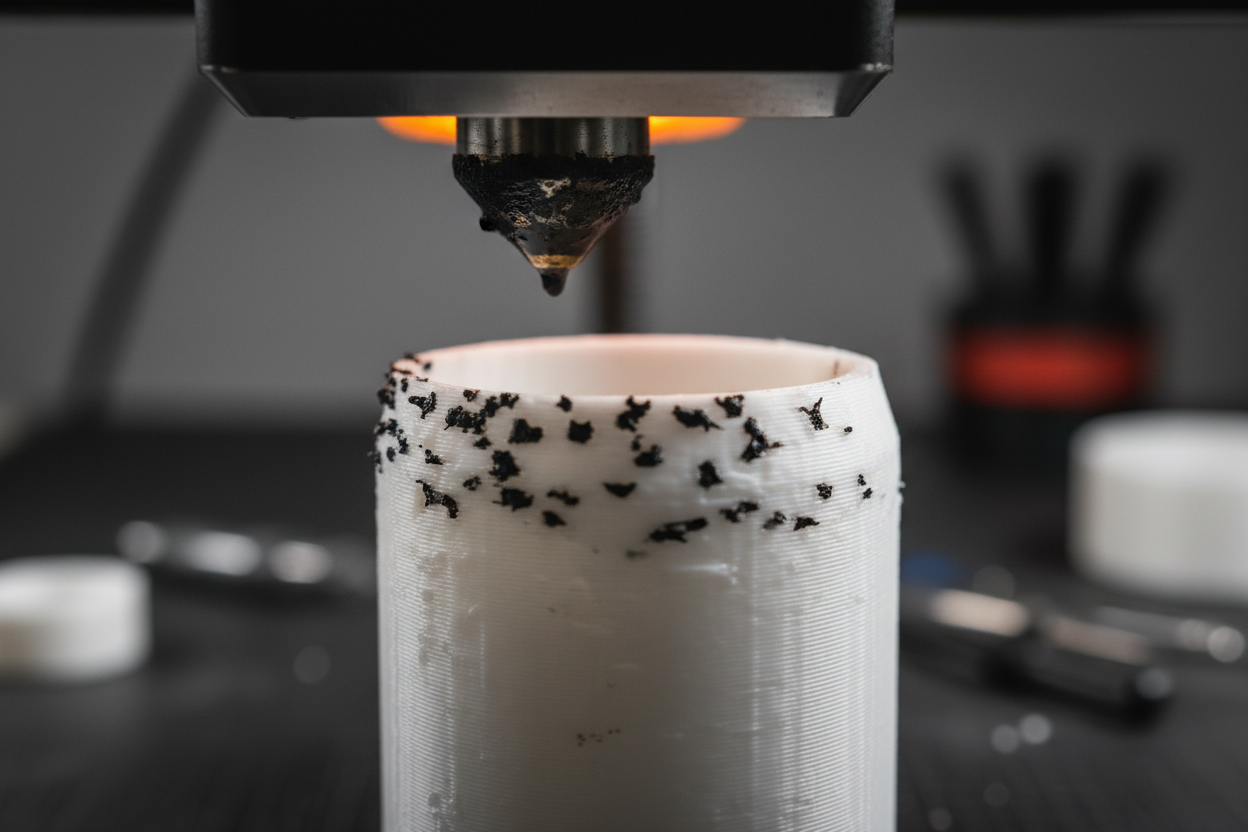
Carbon fiber and glass fiber filaments are abrasive.
A standard brass nozzle can wear quickly.
Better options:
Hardened Steel Nozzles
Great balance of durability and cost.
Ruby or Wear-Resistant Nozzles
Excellent for heavy composite use.
If you print abrasive materials often, nozzle upgrades are worth it.
Increase Temperature Slightly
Many reinforced filaments benefit from printing slightly warmer within the recommended range.
That can improve:
- Flow
- Layer bonding
- Extrusion consistency
Better flow often means less feeding stress.
Always follow manufacturer recommendations.
Slow Down Your Print Speed
This is one of the biggest improvements you can make.
Try reducing speed 25–50%.
Slower printing often gives:
- Smoother extrusion
- Lower feeding stress
- Better consistency
With brittle materials, slower is often better.
Keep Filament Dry During Printing
Drying before printing helps.
Staying dry during printing is even better.
Using a dry box while printing can improve reliability dramatically.
Especially for engineering composites.
Humidity matters.

Best Practices for Carbon Fiber and Glass Fiber Filaments
Quick checklist:
✓ Dry filament before use
✓ Consider removing stressed outer wraps
✓ Keep feed path straight
✓ Minimize sharp bends
✓ Use direct drive when possible
✓ Use hardened nozzle
✓ Raise temp slightly if needed
✓ Reduce speed 25–50%
✓ Print from controlled dry storage
These simple changes solve many breakage problems.
Why Brittle Filaments Are Worth It
Yes, they can be harder to handle.
But they offer major performance benefits.
Fiber-reinforced materials can provide:
- High stiffness
- Excellent dimensional stability
- Lightweight strength
- Professional-grade parts
Great for:
- Jigs and fixtures
- Drone frames
- Functional prototypes
- Robotics parts
- Engineering components
That performance is why many users accept the extra setup care.
Common Mistakes With Brittle Filaments
Feeding Through Tight Curves
Often causes snapping.
Printing Too Fast
Can overload the feed path.
Using Standard Brass Nozzles
Can wear rapidly.
Skipping Drying
A common cause of poor results.
Treating CF Filament Like Regular PLA
It isn’t.
Composite materials usually need different handling.
Final Thoughts
Carbon fiber and glass fiber filaments can be more brittle than standard materials, but that doesn’t mean they’re difficult once properly set up.
Most problems come down to:
- Moisture
- Feeding path stress
- Excessive print speed
- Wrong hardware
Dial those in, and brittle engineering filaments become much more predictable.
And incredibly rewarding to print.
FAQ
Why does carbon fiber filament keep snapping?
Usually because of moisture, tight feed paths, excessive bending, or brittle spool sections.
Do carbon fiber filaments need drying?
Yes. Drying often improves print quality and reduces breakage.
Is direct drive better for brittle filaments?
Often yes. Direct drive usually reduces stress and improves feeding.
Do I need a hardened nozzle for carbon fiber filament?
Yes. Abrasive fibers can wear standard brass nozzles quickly.