
Quick Fix Summary: Warping in 3D Printing
If your 3D prints are curling up from the corners or lifting off the build plate, you are experiencing warping. Warping is mainly caused by uneven cooling, poor bed adhesion, and internal stress released as the material shrinks.
Quick fixes: re-level the build plate, lower the Z-offset slightly, increase bed temperature, use a brim, reduce early cooling, and stabilize ambient temperature (ideally with an enclosure).
What is Warping in 3D Printing?
Warping refers to the phenomenon where corners or the bottom of a 3D-printed model lift upward during the printing process. This causes the printed part to lose secure adhesion to the build platform, ultimately leading to deformation or even print failure.
Warping almost always starts during the first few layers, but the visible deformation often appears later as internal stress accumulates.
Why Warping Happens in 3D Printing
Warping occurs when different parts of a print cool and shrink at different rates. This uneven shrinkage generates internal stress, which pulls the bottom layers upward from the build plate.
Poor Bed Adhesion
If the first layer does not properly adhere to the build plate, the print has a dramatically higher chance of warping later.

Incorrect Z-Offset or Unleveled Bed
When the nozzle is too far from the build plate, filament is not sufficiently squished, reducing contact area and adhesion strength.
Uneven Cooling and Ambient Temperature
Cold drafts, air conditioning, or low room temperatures increase temperature gradients, especially for ABS, ASA, Nylon, and PC.

High Material Shrinkage and Internal Stress
Materials with high shrinkage rates or high internal stress are inherently more prone to warping.
Warping by Material Type
PLA Warping
PLA has a low shrinkage rate and low internal stress, so warping is uncommon on a level build plate. However, very large or dense PLA parts may still warp if cooling is too aggressive or the room is cold.
ABS and ASA Warping
ABS and ASA are highly prone to warping due to high internal stress and higher glass transition temperatures. They require heated beds and benefit greatly from enclosed environments.
PETG Warping
PETG has moderate shrinkage and usually resists warping, but excessive cooling or poor first-layer adhesion can still cause corners to lift.
Nylon and Polycarbonate Warping
Semi-crystalline materials like Nylon warp due to crystallization during cooling, while Polycarbonate requires high temperatures and stable environments to avoid warping.

Advanced Bed Adhesion Methods
Strong bed adhesion is the most effective way to prevent warping.
Common Adhesion Solutions
-
Glue stick: easy and effective for PLA and PETG
-
PEI sheets: excellent for PLA, PETG, and some ABS
-
Specialized adhesives (e.g. Magigoo-type products): ideal for ABS, ASA, Nylon, and PC
How Print Geometry Affects Warping
Print geometry plays a major role in warping, yet it is often overlooked.
-
Large flat bases increase warping risk
-
Sharp corners concentrate stress
-
Rounded corners naturally reduce stress
Print Settings That Increase Warping
Certain slicer settings can unintentionally make warping worse:
-
First layer printed too thin
-
Cooling fan at 100% too early
-
Extremely dense infill near the base
How to Fix Warping in 3D Printing
Improve First Layer Adhesion
-
Re-level the build plate
-
Lower Z-offset slightly
-
Clean the build surface
Increase Bed Temperature
A higher bed temperature reduces temperature differences and keeps the bottom layers flexible longer.
Use a Brim or Raft
Brims increase surface contact area and are one of the most reliable ways to prevent warping.
Reduce Cooling Fan Speed
Reducing cooling during the first layers prevents premature shrinkage.
The Importance of Enclosures
An enclosure stabilizes ambient temperature and reduces drafts, dramatically lowering warping risk.
For ABS and ASA, an enclosure with ambient temperatures of 45–60°C is strongly recommended.

When Warping Leads to Layer Delamination
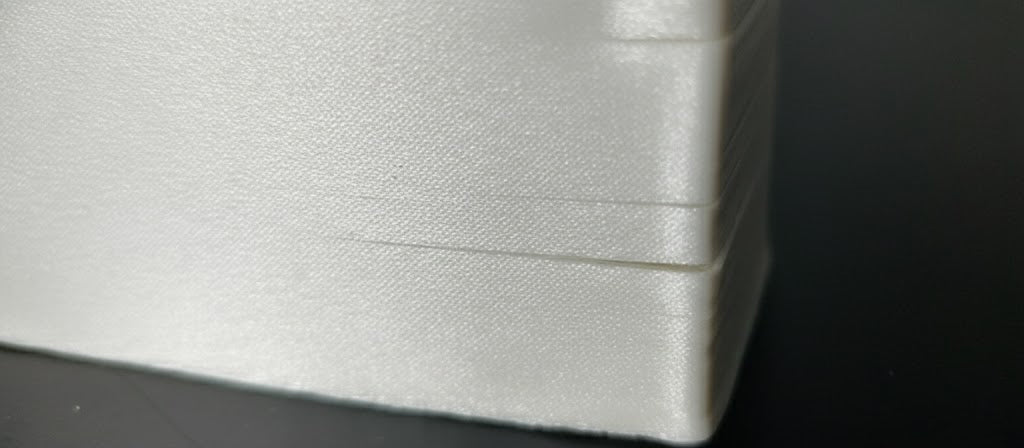
Warping does not only deform parts—it can also increase internal stress and eventually cause layer delamination.
If your print is lifting from the bed and later splitting between layers, you are likely dealing with both issues simultaneously.
For a detailed solution, see our complete Layer Delamination guide.

Summary: How to Prevent Warping
To prevent warping in 3D printing:
-
Ensure strong first layer adhesion
-
Use appropriate bed temperatures
-
Control cooling and ambient temperature
-
Design parts with stress reduction in mind
-
Use an enclosure when required
When these factors are controlled, warping becomes predictable—and preventable.